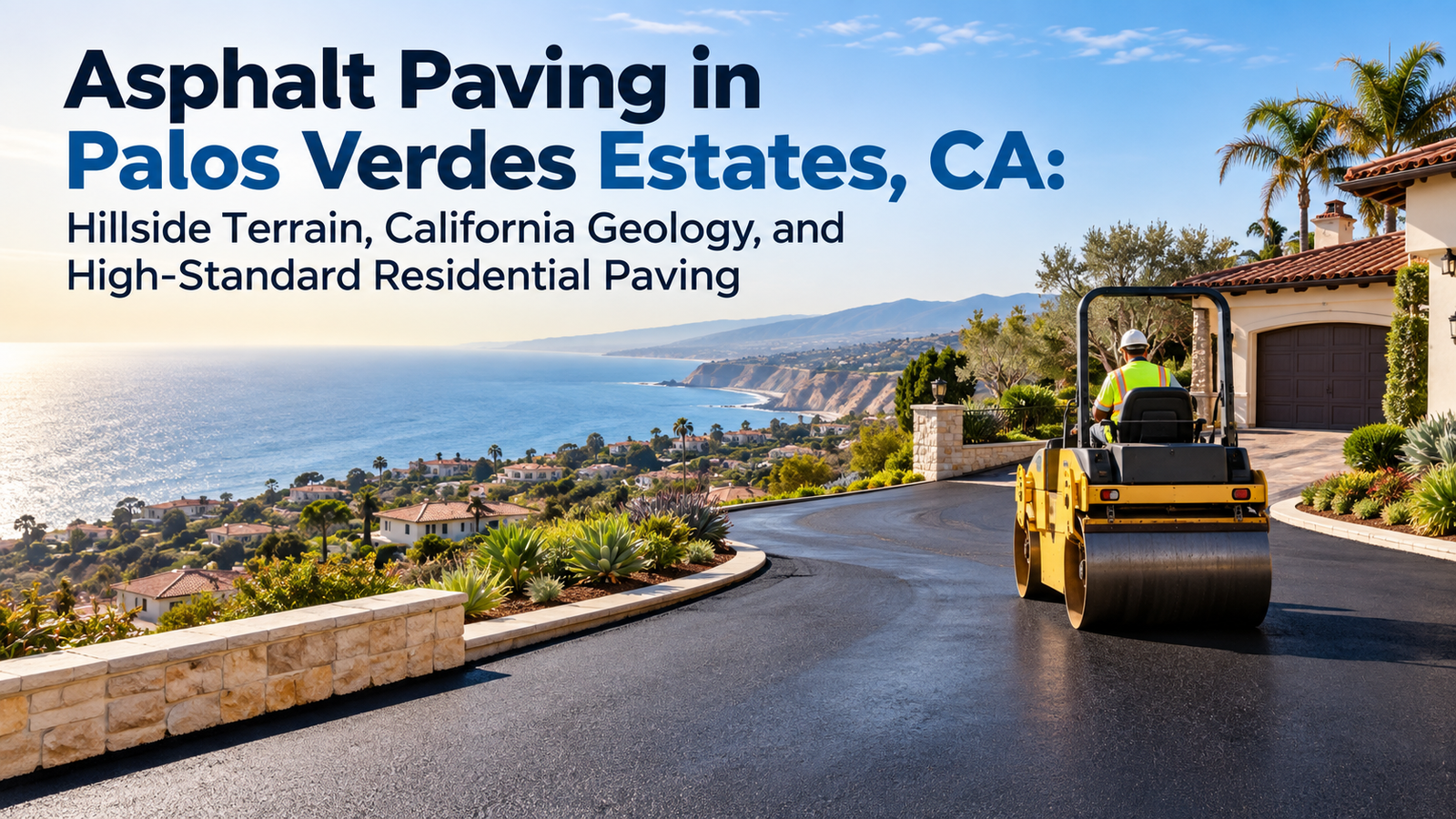
Palos Verdes Estates is one of the four cities that make up the Palos Verdes Peninsula in Los Angeles County. The city occupies the northwestern portion of the peninsula, a rocky headland that rises abruptly from the South Bay coastal plain to elevations of over 1,400 feet above sea level. Its residential character is defined by curvilinear streets following the natural topography, large hillside lots, mature native vegetation, and a commitment to the visual and environmental character of one of Southern California’s most exceptional residential landscapes.
Asphalt Contractor Palos Verdes Estates is shaped by this physical setting in ways that distinguish it from flatland Southern California paving work. The steep hillside terrain creates drainage engineering challenges on every driveway. The peninsula’s geology characterized by ancient marine terraces, landslide-prone clay formations, and active seismicity creates subgrade conditions that have implications for pavement performance that are not present in the flat LA Basin. The aesthetic expectations of a community defined by its visual standards are high. And the climate, moderated by the Pacific Ocean on three sides, is among the most benign for asphalt in Southern California while still presenting UV oxidation and occasional freeze potential at the higher elevations.
The Palos Verdes Peninsula Geology and What It Means for Pavement
The Palos Verdes Peninsula is geologically one of the most complex and dynamic terrains in the Los Angeles Basin. The peninsula is an uplifted marine terrace complex a series of ancient wave-cut platforms that have been elevated above sea level by tectonic uplift. The rock underlying the terraces consists of Miocene-age marine sedimentary and volcanic rocks. The marine terrace surfaces are covered by Quaternary-age terrace deposits silts, clays, sands, and gravel that form the parent material for the soils of the residential hillsides.
The Peninsula Rancho Palos Verdes and Portuguese Bend areas to the east and south are famous for their active landslide complex, but the geology that drives slope instability is present throughout the peninsula. The Altamira Shale and the Monterey Shale, which underlie much of the upper portions of the peninsula including portions of Palos Verdes Estates, contain clay minerals that are highly prone to absorbing water and losing shear strength. Where these formations are exposed at the surface or close to it, subgrade conditions for pavement are challenging: the clays are expansive, weak when wet, and subject to slow creep on even modest slopes.
The practical implication for asphalt paving in Palos Verdes Estates is that subgrade preparation requires more attention than in flatland Southern California. Expansive clays must be properly identified, moisture-conditioned to an appropriate moisture content before compaction, and covered with adequate aggregate base depth to prevent differential swelling from reaching the pavement surface. On steep driveways, the potential for slow soil creep is a long-term pavement performance factor that influences the choice of subgrade treatment and base design.
Hillside Driveway Design in Palos Verdes Estates
The curvilinear streets and large hillside lots of Palos Verdes Estates produce driveway configurations of considerable complexity. Driveways may ascend or descend from the street to the residence at grades of 10 to 20 percent, with curves, transitions, and grade changes along the way. Motor courts at the residence arrival are common, and in some properties, the driveway system includes multiple levels connected by switchbacks.
Drainage design for hillside driveways in Palos Verdes Estates is the most critical engineering element of a paving project. Surface water running down a long driveway at 15 to 20 percent grade can reach erosive velocities that undermine the driveway edge and the aggregate base below. Trench drains or cross-drains at intermediate points along a long driveway intercept concentrated runoff before it erodes the pavement structure. At the base of steep driveways, a catch basin or trench drain at the street connection prevents runoff from flowing onto the public street and creating a hazard.
The cross-slope design of curved driveway sections in Palos Verdes Estates must balance two competing requirements: maintaining positive drainage off the paved surface while not creating a superelevation that causes vehicle discomfort or loss of traction. The design cross-slope in curves is a function of the curve radius, the expected vehicle speed, and the surface friction characteristics of the asphalt mix. Professional driveway paving contractors on the Palos Verdes Peninsula understand this balance and design curve superelevation to manage both drainage and vehicle dynamics.
Palos Verdes Estates’ Mediterranean Climate and Asphalt Longevity
The Palos Verdes Peninsula enjoys one of the most consistently mild climates in Southern California. Temperatures rarely reach 90 degrees Fahrenheit in summer, and freezing is essentially absent at lower elevations. Annual precipitation averages approximately 14 to 16 inches, concentrated in the winter months. The combination of mild temperatures, ocean breezes, and moderate precipitation creates an environment that is relatively gentle for asphalt pavement compared to most of Southern California.
UV radiation remains significant even in the peninsula’s moderated climate, and asphalt oxidation proceeds at a meaningful rate despite the milder temperatures. The absence of extreme heat means that high-performance binder grades are not required PG 64-16 is appropriate for most Palos Verdes Estates applications but sealcoating to protect against UV remains a valuable maintenance investment. The gentler climate means that a three-to-four-year sealcoating interval is appropriate rather than the more frequent two-to-three-year interval recommended for hotter inland locations.
The higher elevations of Palos Verdes Estates above approximately 1,000 feet can experience occasional frost on winter nights, particularly in exposed locations. While freezing is infrequent, the occasional frost event combined with winter rainfall creates a mild version of the freeze-thaw cycle that is so damaging to pavement in colder climates. Cracks that have opened from thermal contraction in the cool season allow brief water infiltration, and the occasional frost event can expand that water in the crack and widen it slightly. Crack sealing before the winter season is appropriate maintenance for Palos Verdes Estates driveways as it is for all Southern California pavement.
Aesthetic Standards and Pavement Presentation in Palos Verdes Estates
Palos Verdes Estates maintains some of the highest property maintenance standards of any city in Los Angeles County. The Palos Verdes Homes Association enforces architectural standards and landscaping requirements that affect how pavement is installed and maintained on residential properties. Driveway materials, edge treatments, and the visual relationship between paved surfaces and the surrounding landscape are considerations that go beyond engineering performance in this community.
Asphalt driveways in Palos Verdes Estates are typically detailed with concrete or natural stone edging that provides both lateral support and a finished visual boundary between the paved surface and adjacent landscaping. Gate entrances, decorative pillars at the driveway head, and motor court designs that complement the residence architecture are all considerations that a professional paving contractor works within when planning an installation or renovation.
The dark surface of asphalt is a practical and aesthetic asset in Palos Verdes Estates: it contrasts well with the natural vegetation palette of the peninsula, absorbs less visual prominence than concrete, and when freshly sealcoated, presents the dark, uniform surface that is characteristic of well-maintained residential pavement in upscale Southern California communities.
Frequently Asked Questions: Asphalt Paving in Palos Verdes Estates
How does the peninsula’s geology affect driveway installation in Palos Verdes Estates?
Expansive clay formations in the Altamira and Monterey Shales require moisture conditioning and adequate aggregate base depth to prevent differential swelling from reaching the pavement. On sloped sites, slow soil creep is a long-term factor in pavement performance.
What drainage features are needed for steep hillside driveways?
Trench drains or cross-drains at intermediate driveway points intercept runoff before erosive velocities develop. Catch basins at the base prevent runoff from reaching public streets. Proper cross-slope design maintains surface drainage off the paved width.
Does Palos Verdes Estates have a freeze risk for asphalt?
At higher elevations above 1,000 feet, occasional frost events occur in winter. While freezing is infrequent, crack sealing before the wet season prevents moisture from entering cracks that can be slightly widened by the occasional frost cycle.
What binder grade is used for Palos Verdes Estates asphalt?
PG 64-16 is appropriate for the peninsula’s mild coastal climate. The extreme high-temperature grades used in the Inland Empire are not necessary in Palos Verdes Estates’ moderate temperature regime.
Are there aesthetic standards for asphalt driveways in Palos Verdes Estates?
The Palos Verdes Homes Association enforces architectural standards that include driveway materials and edge treatments. Concrete or natural stone edging, decorative entrance features, and designs that complement the residence architecture are standard expectations.
Asphalt paving in Palos Verdes Estates combines the engineering demands of hillside terrain and complex geology with the aesthetic expectations of one of Los Angeles County’s most carefully maintained residential communities. Professional paving work on the peninsula brings drainage engineering, subgrade knowledge specific to the peninsula’s geology, and the visual attention to detail that the community’s standards demand producing driveways and paved surfaces that perform as well as they look in one of Southern California’s most distinctive settings.